The Map You Didn't Take: A Post-Outing Ritual That Beats the Camera Roll
There is a particular moment after a good day out when the coats are still damp, the kettle is on, and someone says, “That was a good day.” Everyone agrees. And then, within about twenty minutes, the details start to blur. Not the big stuff — you'll remember the castle, the pier, the rain — but the small stuff. The bench where you stopped. The wrong turn that took you past the strangest little garden. The joke that made everyone laugh near the car park.
Photos capture some of it, but they tend to capture the same version: people smiling in front of things. They rarely capture the shape of the day as you actually experienced it. That's why a hand-drawn map, made from memory once you're home, can be such a quietly brilliant keepsake.
Not the Real Route — the Route That Stuck
This isn't about cartography. Nobody needs an accurate Ordnance Survey rendering of your afternoon in a National Trust garden. The point is to draw the day as it lives in your head: the landmarks that stuck, the bits that went slightly wrong, the places where something funny happened.
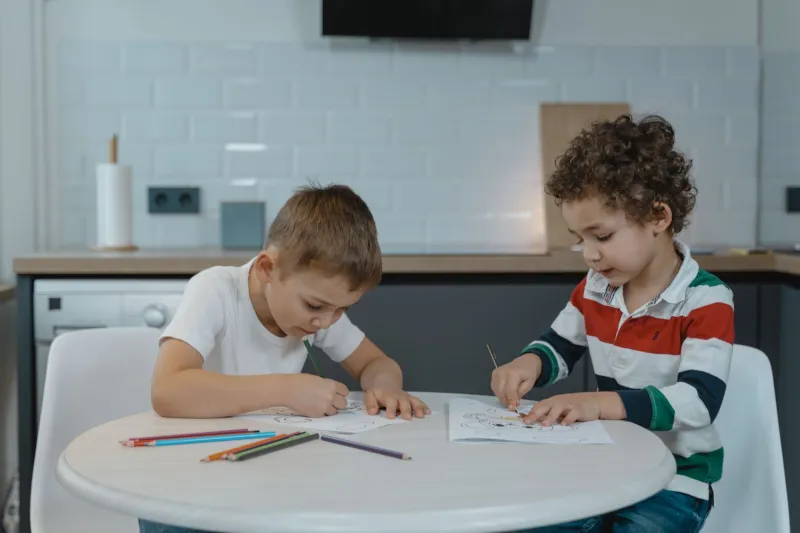
Call it a memory map. Everyone gets a sheet of A4 and a pen. You draw for five minutes, maybe ten. No phones, no checking the actual route on Google Maps, no correcting each other halfway through. Just the day, as remembered.
The results are usually wonky and often hilarious. Someone will draw the tearoom three times the size of the cathedral. Someone else will include the dog that appeared outside the shop but leave out the entire museum. A child might draw only the ice cream and the pigeon that tried to steal it. That's the point. The map shows what mattered, not what happened.
The Rules Are Deliberately Small
You don't need much for this. Paper, pens, and a table big enough for everyone to crowd around. A few simple guidelines help:
- Draw it separately. Everyone sketches their own version without peeking. This is where the surprises come from.
- Keep it rough. Stick figures, arrows, wobbly coastlines and question marks are all welcome. If you can't remember the name of a place, write “the big house with the wonky gate.”
- Include the boring bits if they mattered. The queue for the car park. The bench where someone needed a sit-down. The motorway services that somehow became a highlight because of the sausage roll.
- Date it and name the place. Future you will thank present you for the context.
Five minutes is plenty. The aim isn't a masterpiece; it's a record of what stuck.
What Surfaces When You Compare
Once everyone has finished, lay the maps side by side. This is the good bit. You'll start to see patterns — and disagreements.
One person will have drawn the long walk along the seafront as the main event; another will have drawn the tiny chip shop as the centre of the universe. Someone will remember a wrong turn that felt stressful at the time but now seems funny. Someone else will have completely forgotten it. A child's map might include a random stone they picked up and carried for two miles, which tells you more about their day than any photograph could.
These comparisons are where the shared jokes come back. “Why have you drawn the car park so big?” “Because we spent forty minutes in it.” “What's that circle?” “That's the puddle. The famous puddle.” The map becomes a conversation piece, not a document.
It also reveals the quiet landmarks that don't make it into photos: the gate everyone had to duck under, the shop with the odd sign, the exact spot where the rain finally stopped. These are the details that make a day feel like yours.
A Keepsake That Fits in a Drawer
A camera roll is wonderful, but it's also a bit overwhelming. Thousands of images, all the same size, all jostling for attention. A hand-drawn map is different. It's small, specific, and slightly imperfect. It doesn't need charging or backing up. You can keep it in a folder, stick it in a scrapbook, or pin it to the kitchen noticeboard for a week before it migrates to the drawer of good things.
And unlike a photo, it isn't trying to be the day. It's trying to be your memory of the day — which is a different, stranger, more personal thing. A photograph says, “We were here.” A memory map says, “This is what it felt like to be us, here, on that particular Tuesday.”
For families, it's a lovely leveller. Younger children can take part without needing to write well. Grandparents can join in. Teenagers can draw something deliberately absurd and still be part of it. It works for a big day out at a theme park, a quiet wander around a market town, or a rainy afternoon in a museum where the map ends up being mostly corridors and cake.
Making It a Habit
You don't need to do this after every outing. That would turn a nice ritual into homework. But once in a while — after a birthday trip, a holiday day, a random Saturday that turned out better than expected — it's worth the five minutes.
Keep a small stack of paper and a few pens somewhere obvious. When you get home, before the day dissolves into dinner and screens, put the kettle on and hand out the sheets. No pressure to be clever or artistic. The only rule is to draw what you remember.
Over time, you'll build a very odd, very personal atlas of your family's days out. Not the actual routes, but the routes that stuck. The wrong turns, the big puddles, the benches, the chips. And when you look back at those maps in a year or two, you'll find that they bring back the day far more vividly than a hundred photos ever could.